'%3E%3Cmask id='b' fill='%23fff'%3E%3Cuse xlink:href='%23a'/%3E%3C/mask%3E%3Cuse fill='%23414141' xlink:href='%23a'/%3E%3Cg mask='url(%23b)' fill='%23414141'%3E%3Cpath d='M-160-170h300v300h-300z'/%3E%3C/g%3E%3C/g%3E%3C/g%3E%3C/svg%3E)
Dam Spooky!
Mishmash of Truth and Legend at Hales Bar Dam
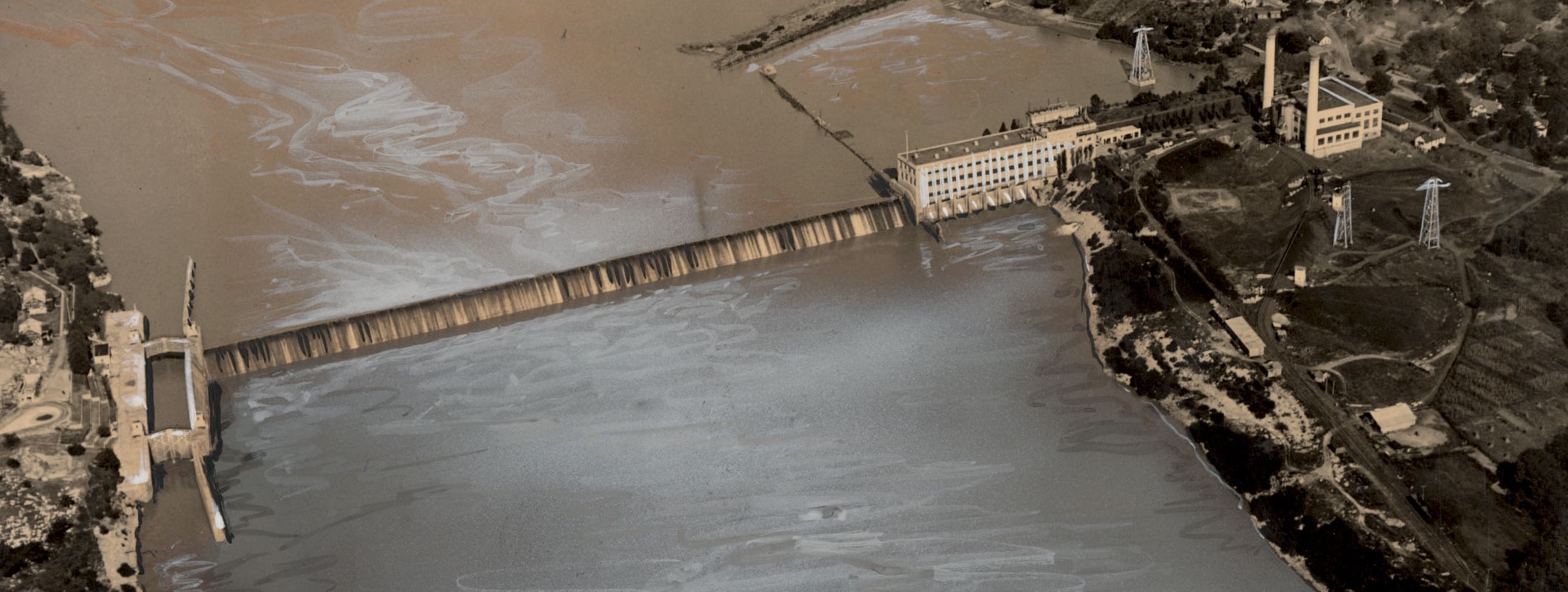
There is nothing like a good ghost story to get the spine tingling. Do a quick internet search on haunted places in Tennessee, and you will eventually find several links to Hales Bar Dam, a former hydropower facility on the Tennessee River in Marion County.
According to paranormal websites, Hales Bar ranks among the top haunted dams in the United States.
Ghost hunters say there are lots of reasons why Hales Bar is haunted, from the dangers of moving into the frontier to a tunnel collapse resulting in the death of children. It is a mishmash of truth and legend, but here is what we can say for sure.
Westward Settlement
In 1775, according to historical accounts, Cherokee leaders agreed to sell a large part of Kentucky and middle Tennessee in the Transylvania Purchase. The deal was not popular among some tribal members.
Part of this land included an especially hazardous section of the Tennessee River below Chattanooga known as “the Narrows” or the Tennessee River Gorge.
As westward settlement continued, there were many accounts of the dangers associated with the Narrows — whirlpools and shoals with colorful names such as the Boiling Pot, the Suck, the Skillet and the Frying Pan. John Donelson, the explorer who cofounded Fort Nashborough in middle Tennessee, documented his trials on this stretch of river in his Journal of a Voyage. As you can imagine, drownings, disease, and conflicts with Native Americans who inhabited the region all led to loss of lives.
This “Valley of the Whirlpool Rapids” had not been tamed by the turn of the 20th century. To improve navigation on this particularly hazardous expanse, and to provide electricity to Chattanooga, Tennessee River Power Company and Chattanooga built Hales Bar Lock and Dam.
The dam has the distinction of being the first main-river, multipurpose dam built on the Tennessee River. Construction began in the fall of 1905.
Rapid Transit
The project employed thousands of men, requiring the construction of a village to feed and house the workers and their families. Because people lived on both sides of the dam, a tunnel 2.5 feet wide and 6.5 feet tall was built underneath the dam to allow easy access from side to side.
One woman remembers going through the tunnel as a kid “I hated it. Many times, there were puddles of water you had to miss and take big steps to walk over or around them. Water would drip on your hair, and it was dark in places where the lights were dim or not lit. It was scary to meet someone you didn’t know, and you would almost have to touch them as they passed by you.”
While the tunnel certainly adds a level of creepiness to the dam, there does not seem to be evidence of a collapse or other tragedy associated with the underground walkway.
Since thousands of men worked three shifts around the clock in wet and muddy conditions without strong safety regulations, it is not surprising that there were injuries and fatalities.
Nonie Webb, expert on Hales Bar, noted that the total number of people injured or killed in accidents at the dam cannot be documented, but she provided examples of the types of violent accidents that occurred during construction. A boiler explosion took the life of one man, a falling derrick crushed out the lives of two others and one man caught his foot in a rope and was pulled underwater, drowning before anyone could save him.
Besides work fatalities, there were also murders at the camps. Along with shootings, there was an incident where a gentleman was struck across the neck with a heavy bench, killing him instantly.
Hales Bar Happenings
While the project was to be completed by 1907, and then 1909, anything that could go wrong, did. There were financial troubles, and four contracting firms failed to complete the project due to difficult foundation conditions.
Then there were the floods. The worst happened in April 1911 with an “avalanche of water” that washed out bridges and damaged train trestles.
The great dam and lock project was finally completed in 1913. The dam itself measured almost one-half mile across and 63 feet high. At the time, the lock was the highest single-lock lift in the world.
With the best modern technology utilized, the dam still leaked. A group known as the “Rag Gang” was hired to walk around and plug leaks for $1 a day.
The original company that constructed the dam merged with other companies to form the Tennessee Electric Power Company in 1922. They managed Hales Bar until TVA acquired all TEPCO facilities in 1939.
TVA made a number of improvements to Hales Bar Dam over the years, such as constructing a “curtain” across the face of the dam to stop leaks and even raising the reservoir four feet to permit dredging of a navigation channel.
In the 1960s, TVA decided it was time to replace Hales Bar due to persistent leakage through its poor foundation rock. A new dam, Nickajack, was built 6.5 miles downstream, and Hales Bar Dam was demolished.
No longer a part of TVA, the powerhouse stands in its original location on the Tennessee River. It is a concrete reminder of days gone by, itself a ghost, whether any inhabit it now or not.