'%3E%3Cmask id='b' fill='%23fff'%3E%3Cuse xlink:href='%23a'/%3E%3C/mask%3E%3Cuse fill='%23414141' xlink:href='%23a'/%3E%3Cg mask='url(%23b)' fill='%23414141'%3E%3Cpath d='M-160-170h300v300h-300z'/%3E%3C/g%3E%3C/g%3E%3C/g%3E%3C/svg%3E)
Underwater Education
Exploration Helps Students Understand Home Rivers
On the banks of the Pigeon River, Dave Matthews spun a tale.
“There’s something very special about this fish,” the Tennessee Valley Authority aquatic zoologist said.
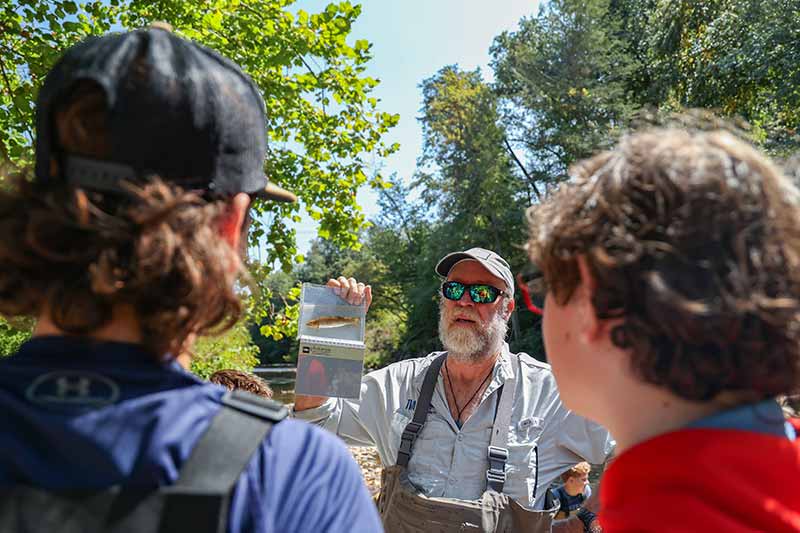
As he held a Northern hogsucker aloft, a dozen kids crowded around to get a close-up look at its puckered lips – perfect for slurping aquatic insects from the river bottom.
“Legend has it that if this fish kisses you, it’ll bring you good luck,” Matthews said. “Anybody want to try?”
Some brave students stepped forward. Matthews oh-so-gently let the fish’s mouth graze their cheeks.
“It’s cold!” one student yelped.
“My first kiss was a fish!” a boy crowed.
The kids had come to the Pigeon River not only for fish kisses, but for a day of field-based education as part of Kids in the Creek.
Since 1996, all eighth grade students from Haywood County, North Carolina, have spent a day netting fish and aquatic insects, testing water samples and understanding how human activities on land affect the river, said Christine O’Brien, of Haywood Waterways Association.
Decades ago, Richie Ruth, a retired TVA employee, and the French Broad Watershed Team reached out to aquatic conservation partners to create this day of learning for kids.
Since then, about 18,000 Haywood County kids have participated.
“We talk to every middle school student,” Matthews said. “In the future, they’ll be community leaders, business owners and residents. And they’ll remember this day and what clean water means.”
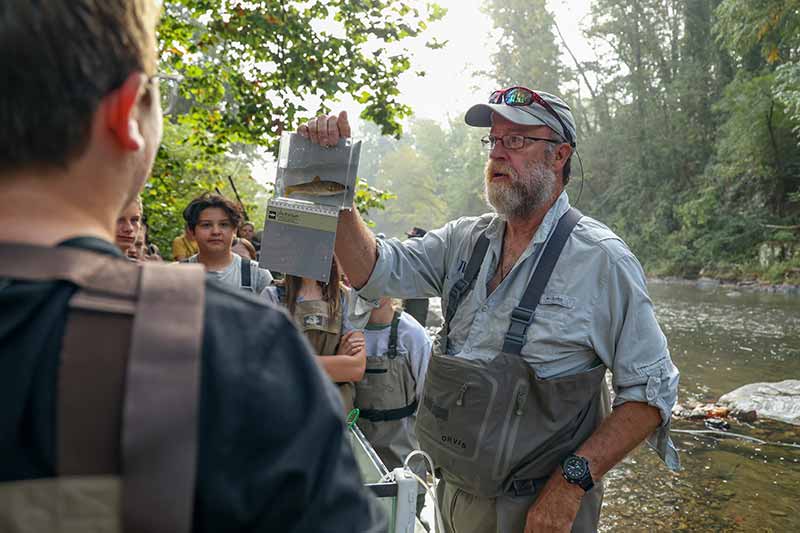
Dave Matthews, TVA aquatic zoologist, talks about the importance of many species of healthy small fish to the river system as a whole. (Photos by Susan Ehrenclou / TVA)
'It’s Go Time’
Early in the cool morning, when mist still snagged on trees over the river, dozens of Waynesville Middle School eighth graders spilled from school buses at the Canton Recreation Park in western North Carolina.
“It’s go time,” O’Brien said.
The kids spread out to four stations – watershed education and water chemistry on land, and benthic macroinvertebrates and fish in the river.
At the fish station, fallen sycamore leaves floated on the current like tiny Viking boats, their toothed edges curled upward into brown, dry scrolls.
Matthews stood ready with North Carolina Wildlife Resources Commission aquatic biologist Dylan Owensby and technician Quentin LaChance.
“Why is this a good spot for so many kinds of fish?” Owensby asked the kids.
“Water,” one student deadpanned. His classmates laughed.
“Yes, water – and it’s clean,” Owensby said. “If you look behind us, you see flat slackwater, fast water and pools. Fish take advantage of all those different habitats and food sources.”
That’s why there are so many different freshwater fish here – 32 species in the Pigeon River, 257 in North Carolina and 32,000 in the world.
“All of the other vertebrate species combined don’t equal the number of fish species,” Owensby said.
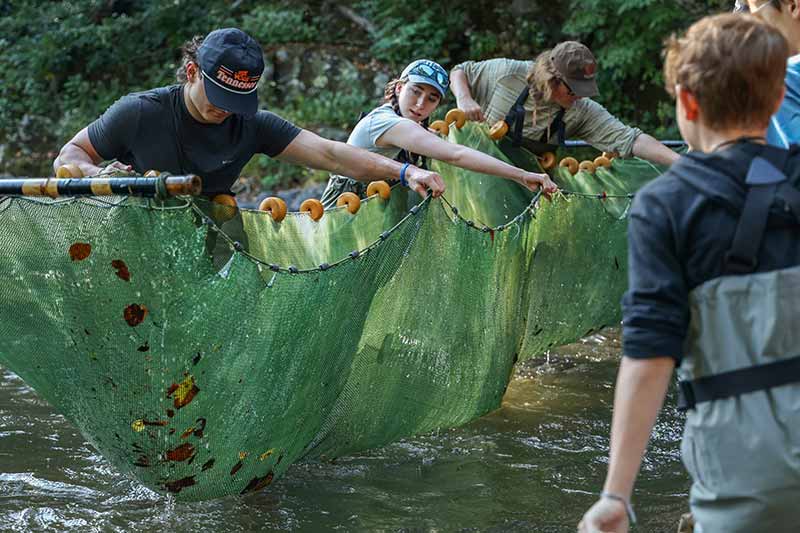
Haywood Community College students scoop fish, crayfish and aquatic insects for middle schoolers to study.
House Full of Popcorn
To keep tabs on river life, scientists conduct an Index of Biological Integrity – a sample of fish and aquatic insects.
Across the Valley region, TVA and its partners monitor rivers and reservoirs as part of their environmental stewardship mission.
It’s one way TVA helps improve lives, bringing billions of dollars into local economies for recreation and conservation and saving billions of dollars in flood damage.
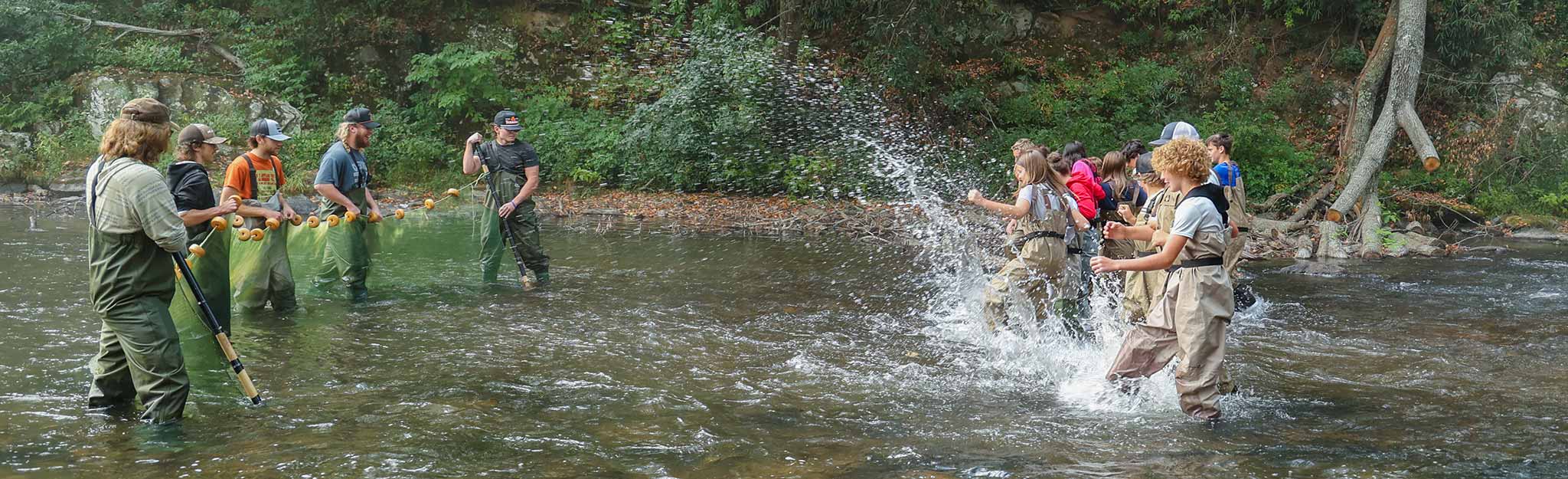
Matthews showed them how the Index was done. He had students link arms across the river. Then they stomped and splashed to herd fish into a long seine net Haywood Community College students held.
Matthews helped the kids identify fish they found, linking each species to river health.
“This is a bigeye chub,” Matthews said. “They depend on sight – they’re sight feeders. So they need clear, clean water.”
He introduced students to darters – tangerine, banded, gilt, little greenfin and Tuckasegee, which live only in western North Carolina – and silver and warpaint shiners. Besides the bigeye, students met the river chub and smallmouth and rock bass and, of course, got a chance to smooch the Northern hogsucker.
“The (Index of Biological Integrity) tells us about … the health of the river overall,” Owensby said. “We want many kinds of fish, and fish that are sensitive to pollution.”
Every group knew what type of pollution posed the biggest threat.
“Sediment!” they called.
Sediment runs off farm fields without a filtering plant buffer when it rains. Sediment billows from uncovered earth at construction sites and flows from roadways into storm sewers.
“I’ve used this analogy,” Matthews said, to describe how sediment harms rivers. “The house is there. But it’s full of popcorn, so nobody can live in it.”
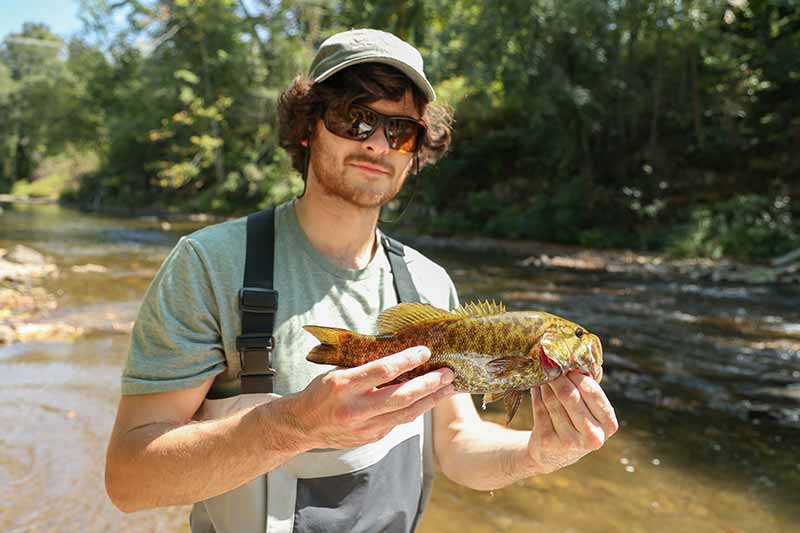
Quentin LaChance, North Carolina Wildlife Resources Commission technician, shows students a healthy fish from the Pigeon River.
'Changing Hearts and Minds’
As the kids rotated to the other stations, they learned about the rest of the story.
At the Watershed Education station, Addie Ruff and Susie Bradley taught kids about runoff that flows into the Pigeon to the French Broad, Tennessee and Mississippi rivers all the way to the Gulf of Mexico.
At the water chemistry station, Mark Ethridge, of Haywood Waterways, pulled rubber poop from his pocket – a source of nitrates that kids tested for, along with pH and dissolved oxygen.
And at the benthics station, which the U.S. Fish and Wildlife Service and Haywood Waterways ran, kids grabbed D-nets and bowls and waded into the river with Haywood Community College guides.
“Kick kick kick!” student Dana Charles cheered. “Wiggle wiggle wiggle. Yes! Look what you found.”
On the bank, Keiffer Owen, of Haywood Waterways, helped kids navigate a dichotomous key.
“Does it have legs? How many tails?” he asked. Kids called out answers, narrowing down their creature’s identification to a clean-water-loving stonefly.
Byron Hamstead, of the U.S. Fish and Wildlife Service, moved between groups.
“Of all the conservation tools we have – including policy and regulatory outreach – education is the most powerful, desirable and sustainable,” Hamstead said. “Changing hearts and minds is the best conservation tool we have.”

Students learn how fish they see in the river link to water quality.
‘A Legacy Program’
On the riverbank, Matthews let the hogsucker graze each student’s cheek.
“Now your test scores are going to get better,” he said, smiling. “Your football team is going to win.”
And part of that is undoubtedly true.
Haywood County students’ biological science test scores are high – and teachers credit this program in large part.
“As far as our standards go, this really helps,” social studies teacher Salem Parris, from Waynesville Middle School, said. “The kids love it. They talk about getting in the water and having fun. But it especially helps them understand the runoff and impacts.”
Hands-on experience is invaluable – and long-lasting.
“We have kids coming through whose parents went through,” Matthews said. “It’s a legacy program.”
Instructors Andrew Isenhower and Shannon Rabby brought their Haywood Community College ichthyology, wildlife and forestry classes. The students not only held nets and helped kids wiggle into waders but also learned more about what parts of the conservation world they may want to pursue.
Rabby himself served as a college student helper years ago – it helped guide him to his career as a conservation educator.
“These kids, when they’re moving, doing things with their hands, they’re engaged,” Parris said. “Being out here taking samples, being in the water, (the students) care. And when they care, they learn better.”
“Conservation ideas start early,” Matthews said. “That’s how you make things happen. You change that (mindset) early on.”
One boy galloped across the river and danced back and forth in his waders. He answered almost every fish question correctly.
LaChance held a smallmouth bass up for students to see.
“It glistens in the sun!” the boy said. "I love fish.”
“Me, too,” Matthews agreed.
Photo Gallery
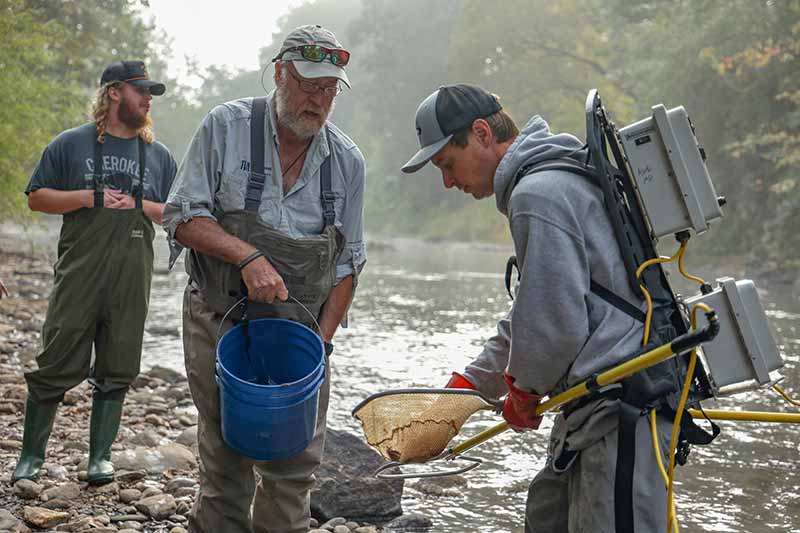
Matthews and Dylan Owensby, North Carolina Wildlife Resources Commission aquatic biologist, collect fish for the display tank at the Pigeon River with the help of Haywood Community College Students.
Sediment and pollutants that run into water from the landscape are threats to fish. The Pigeon River, in Canton, North Carolina, runs clear and clean.
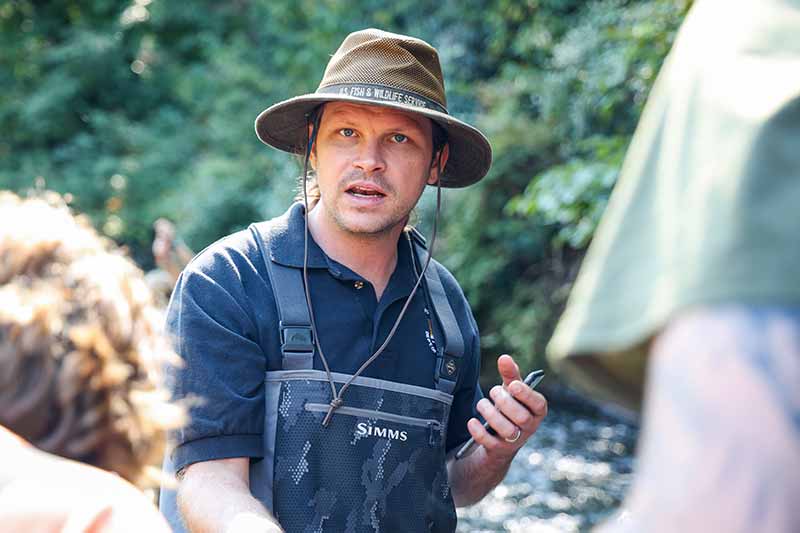
Byron Hamstead, U.S. Fish and Wildlife Service, teaches kids about aquatic insects with the help of Haywood Community College students.
PHOTO AT TOP OF PAGE: Middle schoolers stomp and splash to herd fish into the seine nets that Haywood Community College students hold. Fish they find will tell scientists about the Pigeon River's health.
Susan Ehrenclou
Staff Writer
Share this story: ' fill='%23414141'%3E%3Cpath d='M0 0h314v314H0z'/%3E%3C/g%3E%3Cg transform='translate(6 4)'%3E%3Cmask id='d' fill='%23fff'%3E%3Cuse xlink:href='%23c'/%3E%3C/mask%3E%3Cuse fill='%23FFF' xlink:href='%23c'/%3E%3Cg mask='url(%23d)' fill='%23FFF'%3E%3Cpath d='M-149-165h300v318h-300z'/%3E%3C/g%3E%3C/g%3E%3C/g%3E%3C/svg%3E%0A)
' fill='%23414141'%3E%3Cpath d='M0 0h314v314H0z'/%3E%3C/g%3E%3Cg transform='translate(4 5)'%3E%3Cmask id='d' fill='%23fff'%3E%3Cuse xlink:href='%23c'/%3E%3C/mask%3E%3Cuse fill='%23FFF' xlink:href='%23c'/%3E%3Cg mask='url(%23d)' fill='%23FFF'%3E%3Cpath d='M-167-171h323v327h-323z'/%3E%3C/g%3E%3C/g%3E%3C/g%3E%3C/svg%3E%0A)
' fill='%23414141'%3E%3Cpath d='M0 0h314v314H0z'/%3E%3C/g%3E%3Cg transform='translate(4.26 4)'%3E%3Cmask id='d' fill='%23fff'%3E%3Cuse xlink:href='%23c'/%3E%3C/mask%3E%3Cuse fill='%23FFF' xlink:href='%23c'/%3E%3Cg mask='url(%23d)' fill='%23FFF'%3E%3Cpath d='M-150-157h300v300h-300z'/%3E%3C/g%3E%3C/g%3E%3C/g%3E%3C/svg%3E)
Want more stories from The Powerhouse? Sign up to receive a monthly digest in your email.
Inspiring New Generations
Since this story was written, many of western North Carolina’s communities experienced damage from the remnants of Hurricane Helene. As people work together to recover, they’re also assessing the impact of the flooding on river life and habitats. Educational events such as Kids in the Creek help create a new generation that cares and is knowledgeable about river systems in their communities.