'%3E%3Cmask id='b' fill='%23fff'%3E%3Cuse xlink:href='%23a'/%3E%3C/mask%3E%3Cuse fill='%23414141' xlink:href='%23a'/%3E%3Cg mask='url(%23b)' fill='%23414141'%3E%3Cpath d='M-160-170h300v300h-300z'/%3E%3C/g%3E%3C/g%3E%3C/g%3E%3C/svg%3E)
The Power of Water
Lake Chatuge Residents Look to Past for Future Hope
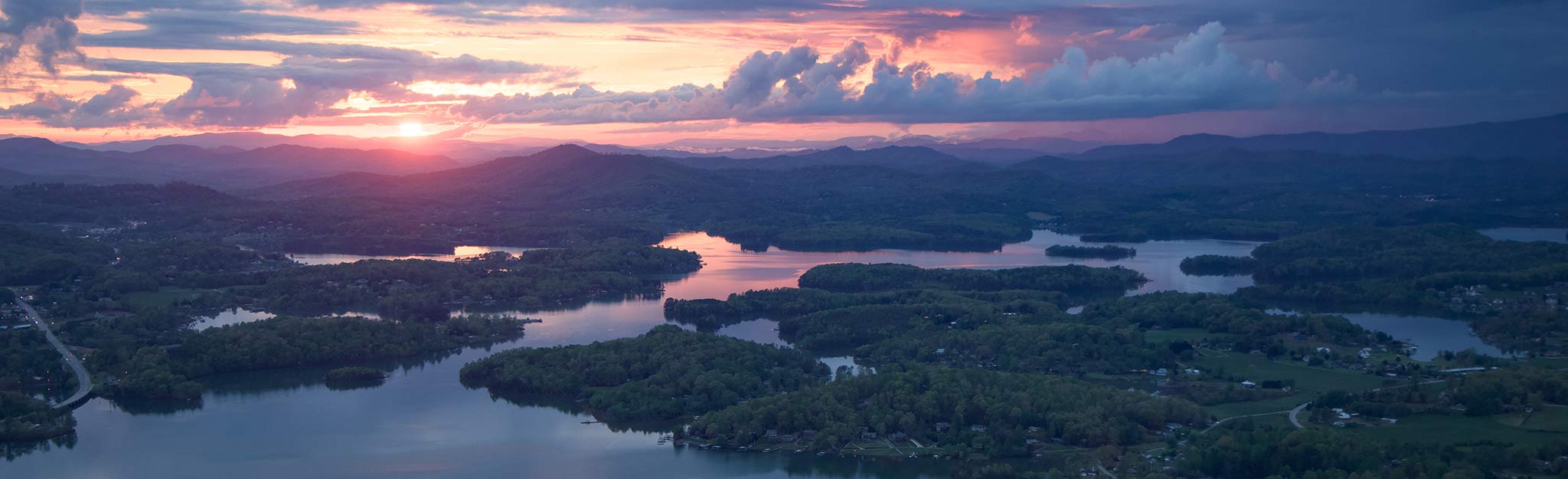
Lake Chatuge sits among the mountains like a jewel resting in the palm of a great hand. From the lake you can see clear to Bell Mountain, and from Bell Mountain you can see what seems like forever.
The lake stretches from North Carolina to Georgia. But there’s an even longer view here, not across distance but across time; a view enjoyed by historians and librarians.
Franklin Shook, who manages three libraries in the area, sat recently at a table piled with old maps and books about the history of the place.
In 1938, TVA granted money to create a camp library for dam workers, he said, “so we supplied books.” He’s 39 years old, but he talks as though he can remember the books coming in by wagon. “We purchased books and built a library there for the workers.”
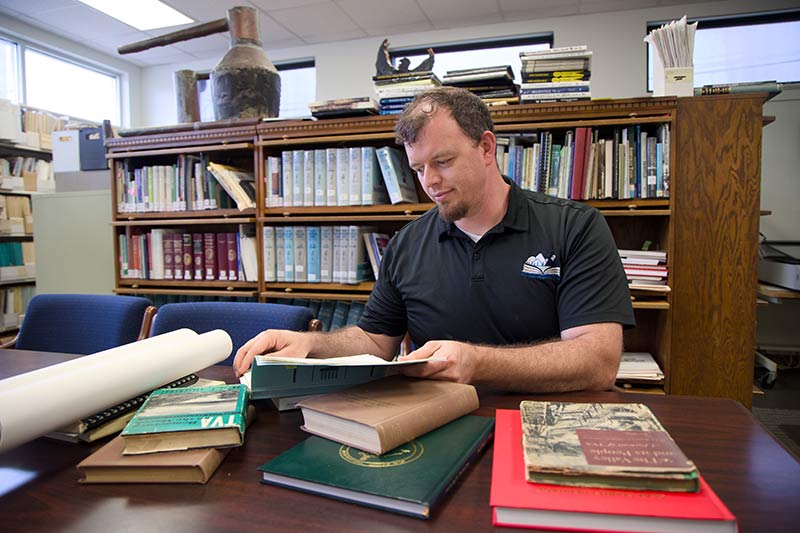
Franklin Shook at the Hayesville library.
History is still present for a lot of people here. It’s a topographical feature. They watch the sun set beyond it every day. They swim in it, drive over it, drink it from glasses sitting on their nightstands. They picnic in sight of TVA’s tower and contemplate its Art Deco lettering: CHATUGE.
“My mother’s family lived about where the top of the spillway is now,” Rob Tiger said recently, in Hayesville.
He’s the fifth-generation proprietor of the town’s general store and the soda counter next door. It’s a pleasant jumble of chrome stools and tourist knickknacks and root beer floats.
It’s been there a long time, so it’s natural that 74-year-old Tiger has become the town’s unofficial historian. The lake’s displacement of some local families is still a subject of keen interest, he said, but now the same lake “is a lifeblood of our economy.”
The past, again, is present. Eighty-three years ago, people here felt their lives were disrupted by the rising of the water. Now, as TVA prepares to address the risk to the dam’s spillway, a new generation feels the same about the waters subsiding during the years-long work.
It’s worth exploring that history.
On July 4, 1943, as the Second World War raged in both Europe and the Pacific, the Asheville Citizen-Times ran a headline the full width of the newspaper: “Hiwassee River Power Turns Wheels of War Industries.” It outlined how the Tennessee Valley Authority, in order to meet wartime demands for materials like aluminum, had constructed a chain of dams along the Hiwassee River for flood control, water storage and electricity production.
Workers had finished Chatuge Dam in 1942, and a dozen years later they added a power-production component.
No one knew what to make of it at first.
“No one wanted to live on the lake,” Tiger said.
But a gradual shift happened in the human landscape. In the second half of the 20th century the manufacturing jobs that sustained the area dried up. Timber work ended, and the mines closed. The old sheet metal place shut down. So did the dress factory.
But people still had the lake, with its one-word declaration: CHATUGE.
Tourism replaced the old industries. People came up from Atlanta and down from Asheville.
Recently a car full of visitors – the Tanner family – pulled off Highway 64 onto an unmarked lake access point locals call The Circle, and fired up a grill.
“This is our spot,” Mike Tanner said. “It’s just perfect.”
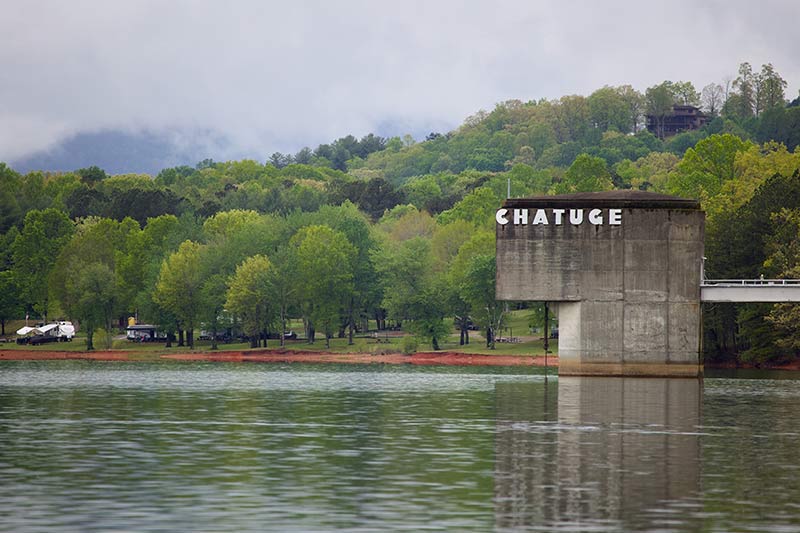
The Chatuge intake tower.
The lake, as Tiger said, has become the area’s lifeblood.
That matters to TVA, according to lead engineer Chris Saucier, and it’s one of the reasons TVA has committed to keeping the dam safe for generations to come.
Recently, engineers discovered that joints in the concrete spillway had aged, and that if a large enough volume of water flowed into the spillway, it could erode the ground beneath it, threatening the spillway and the dam itself.
There’s no emergency, yet the conditions create an unacceptable risk, Saucier said, so TVA is considering several options for how to address it. Solutions range from rehabilitating the spillway in place to building a new one.
TVA will draw down lake levels during the work which, at most, could take eight years.
“That’s the worst-case scenario,” Saucier said. “We will be working to lower that number as we move ahead, and I expect it will lower.”
Reaction from residents has been mixed. The communities around the lake depend on it. But people in the area have also recently seen the destructive power of overwhelming rainfall.
“I understand they need to maintain the system in the safest way possible,” Tiger said. “When Helene was headed our way last September, I think people underestimated the power of water. It was headed straight for us, then it took a little bit of an easterly cut. I was wondering the whole time whether the dam would hold up. And I guess it would, but they’d have to keep the spillway wide open.”
It’s true the repair work will pose economic challenges, Tiger said, but his memory is long. He remembers substantial winter drawdowns from his teenage years.
“We used to motorcycle the shoreline,” he said, grinning. “We would ride into Georgia, unobstructed.”
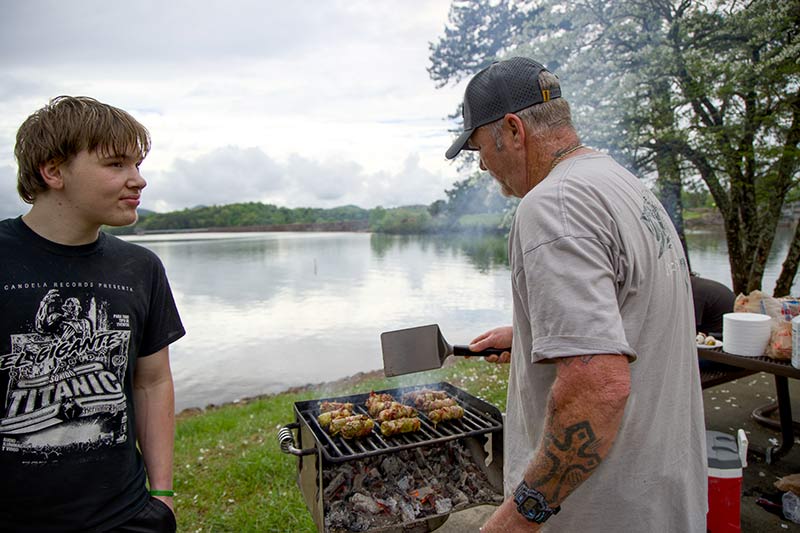
Mike Tanner and his 17-year-old son, Mason
At The Circle, the Tanner family teenagers thrilled at that idea: Motorcycles! Their mother, Tonya, shook her head and said, “I do think it would be interesting to see what’s under the water.”
So they’ll continue to visit during lower lake levels?
“We’re here once a week during the summer,” Mike said. He reached with tongs to turn his specialty: hamburger-stuffed dill pickles. “We don’t plan on stopping.”
Beyond him – beyond the grill, beyond the lake, beyond the mountains – the sun began to set. Blues became oranges, and greens became purples: splendor, in a land of long views.
PHOTO AT TOP OF PAGE: Lake Chatuge from Bell Mountain.
Share this story: ' fill='%23414141'%3E%3Cpath d='M0 0h314v314H0z'/%3E%3C/g%3E%3Cg transform='translate(6 4)'%3E%3Cmask id='d' fill='%23fff'%3E%3Cuse xlink:href='%23c'/%3E%3C/mask%3E%3Cuse fill='%23FFF' xlink:href='%23c'/%3E%3Cg mask='url(%23d)' fill='%23FFF'%3E%3Cpath d='M-149-165h300v318h-300z'/%3E%3C/g%3E%3C/g%3E%3C/g%3E%3C/svg%3E%0A)
' fill='%23414141'%3E%3Cpath d='M0 0h314v314H0z'/%3E%3C/g%3E%3Cg transform='translate(4 5)'%3E%3Cmask id='d' fill='%23fff'%3E%3Cuse xlink:href='%23c'/%3E%3C/mask%3E%3Cuse fill='%23FFF' xlink:href='%23c'/%3E%3Cg mask='url(%23d)' fill='%23FFF'%3E%3Cpath d='M-167-171h323v327h-323z'/%3E%3C/g%3E%3C/g%3E%3C/g%3E%3C/svg%3E%0A)
' fill='%23414141'%3E%3Cpath d='M0 0h314v314H0z'/%3E%3C/g%3E%3Cg transform='translate(4.26 4)'%3E%3Cmask id='d' fill='%23fff'%3E%3Cuse xlink:href='%23c'/%3E%3C/mask%3E%3Cuse fill='%23FFF' xlink:href='%23c'/%3E%3Cg mask='url(%23d)' fill='%23FFF'%3E%3Cpath d='M-150-157h300v300h-300z'/%3E%3C/g%3E%3C/g%3E%3C/g%3E%3C/svg%3E)
Want more stories from The Powerhouse? Sign up to receive a monthly digest in your email.
Chatuge Dam
Learn more about the proposed changes to Chatuge Dam at the Chatuge Dam Safety Modifications page.