'%3E%3Cmask id='b' fill='%23fff'%3E%3Cuse xlink:href='%23a'/%3E%3C/mask%3E%3Cuse fill='%23414141' xlink:href='%23a'/%3E%3Cg mask='url(%23b)' fill='%23414141'%3E%3Cpath d='M-160-170h300v300h-300z'/%3E%3C/g%3E%3C/g%3E%3C/g%3E%3C/svg%3E)
Generating Buzz
Award-winning partnership with Tennessee Environmental Council creates beautiful school gardens, bolsters native bee populations and inspires education
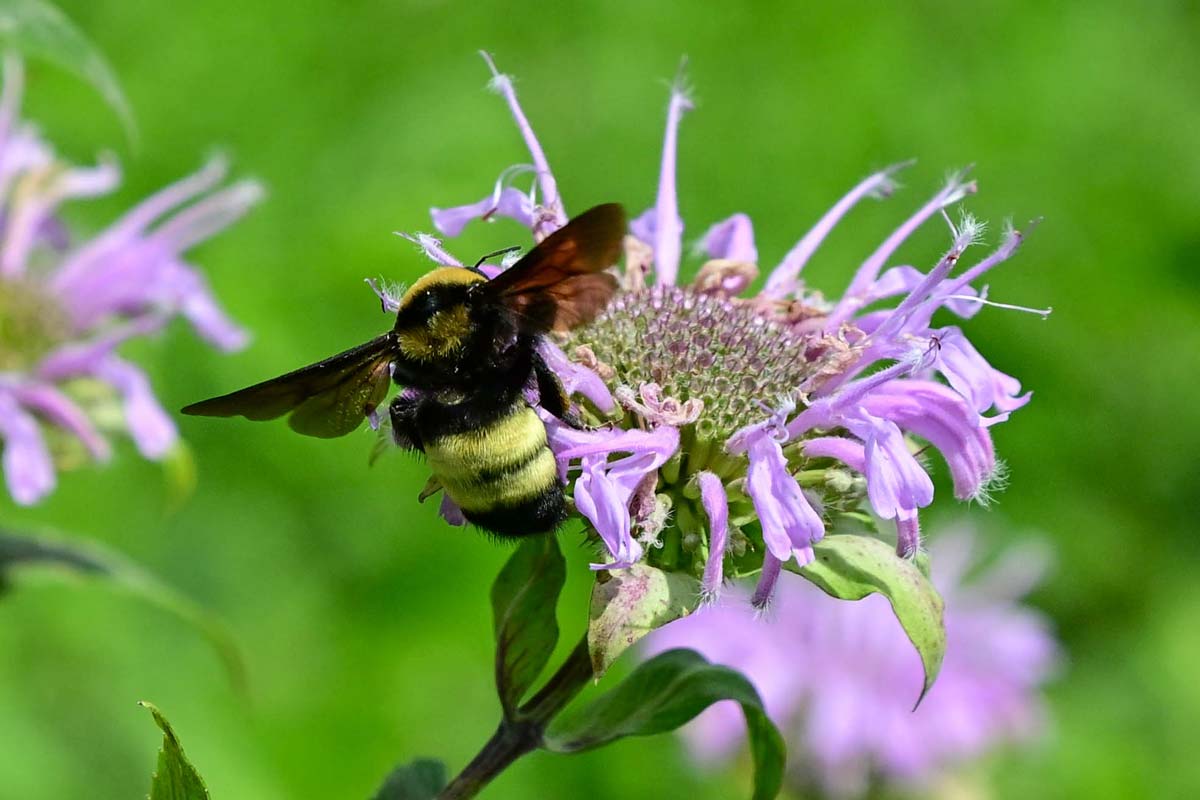
In the heat of a humid day, wildflowers bent low under the weight of bumblebee bodies.
The air hummed with busy buzz.
This native pollinator garden was one of dozens planned, planted and maintained at Nashville area schools through a partnership between the Tennessee Environmental Council and Tennessee Valley Authority.
Gardens are designed so each season brings new blooms.
Spring milkweed blazes orange around a baseball field.
Summer’s black-eyed Susans stand amidst a dense, multicolor bouquet – and nectar buffet – and give way to fall’s goldenrod and asters.
The gardens sustain student learning, bolster declining native pollinator and plant populations and bring beauty to Nashville’s neighborhoods.
“This allows kids to have a hands-on positive experience,” said Heather Hart, TVA Environmental Resource Stewardship program manager. “It’s a great way to learn.”
It’s also a way to restore habitat in the Southeast, where 90 percent of native grassland area vital to pollinators – and therefore people – has been lost to development.
“It’s a really special partnership,” said Dr. Monika Pretz, Tennessee Environmental Council Pollinator Program director.
‘It’s just beautiful’
At Stratford STEM Magnet School alone,19 gardens range from small plots between walkways to curvilinear showpieces in front and long stretches under TVA transmission rights-of-way in back.
Flowers and grasses produce nectar, pollen and seed and bring in insects. Those draw in songbirds and other small creatures. Soon, predators such as hawks appear, too.
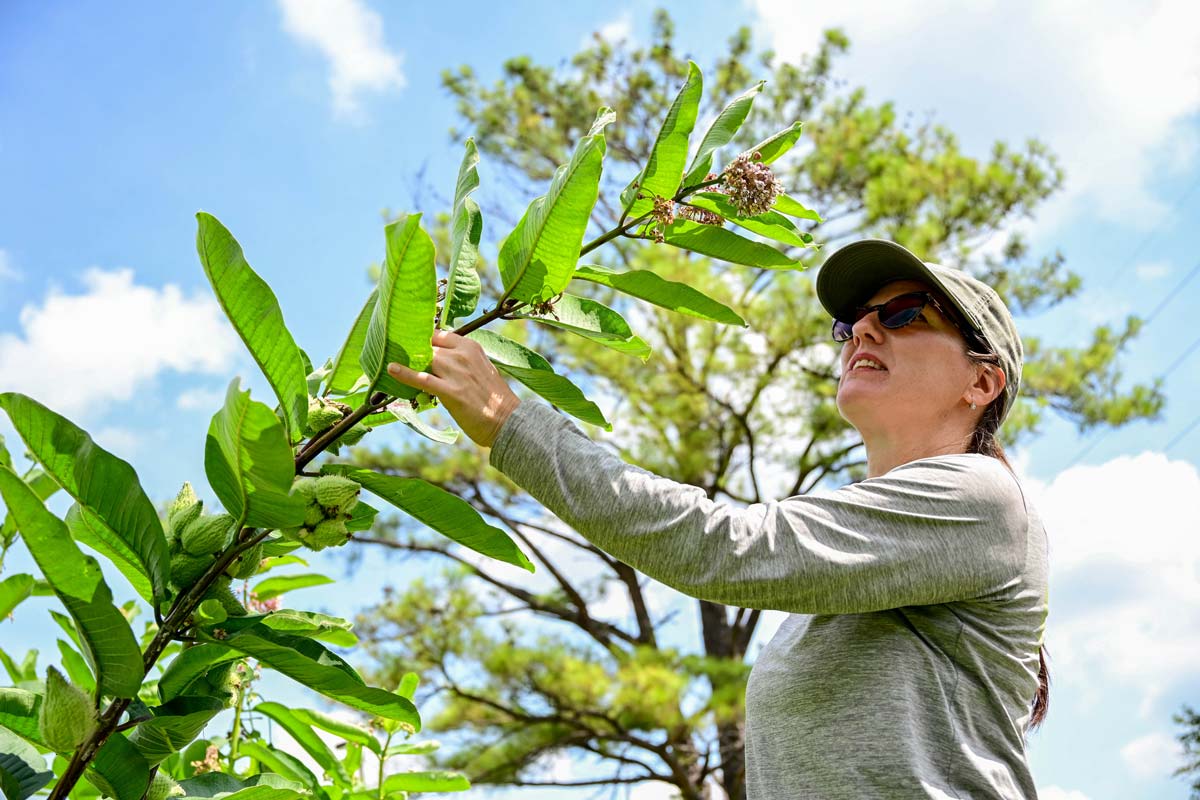
“That’s how a healthy ecosystem works,” Pretz said. “You start with the native plants.”
Students visit the on-site gardens to study environmental science, plant-pollinator interactions, botany, water infiltration, the food web and more.
“You can connect these gardens to other subjects in so many ways: science, writing and art,” said Jeff Barrie, Tennessee Environmental Council CEO.
And kids who may not have yards of their own learn to love being outside.
“Over time, they’re open to observe and learn,” Pretz said. “It’s just beautiful.”
The Council has planted 70 gardens in all, most within an hour of Nashville, and the effort is growing.
“We train advocates and ambassadors all over Tennessee,” said Pretz. “We really want to expand our Pollinator Initiative state-wide.”
More gardens – and many more bee species – have led to collaborative research to study urban native bee populations with Lipscomb University.
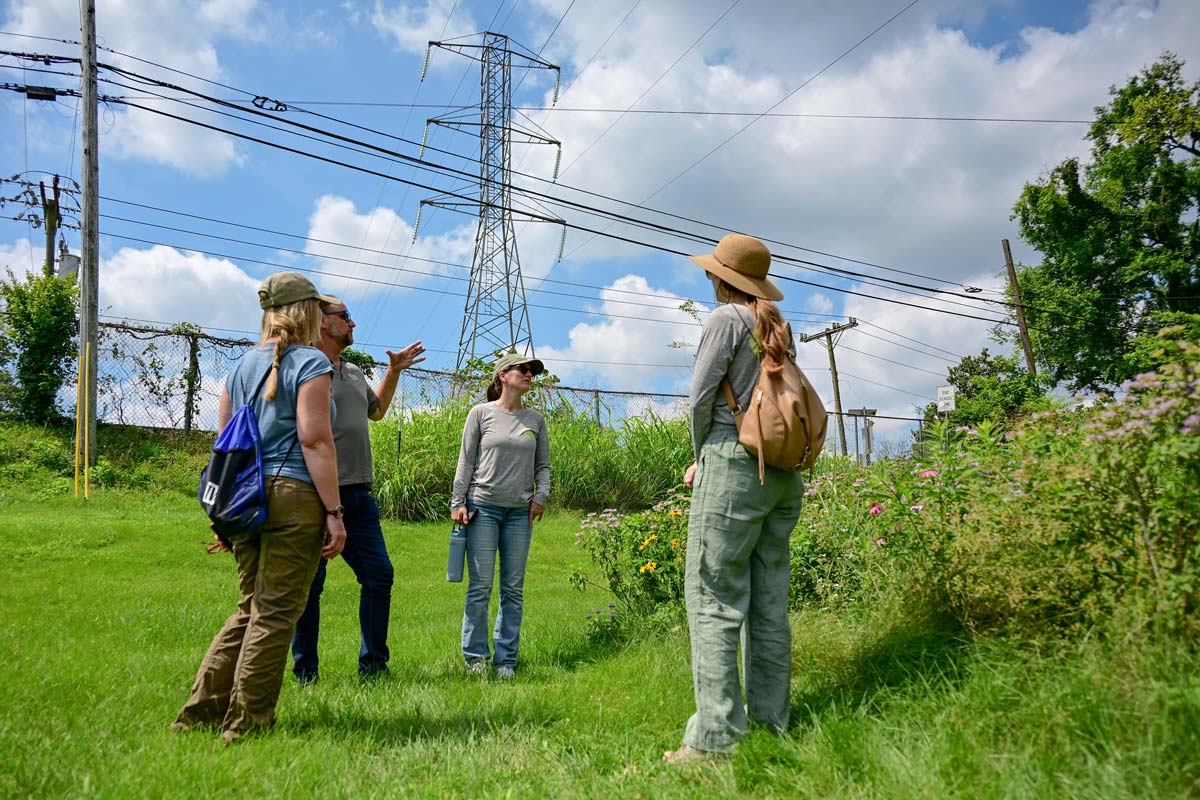
This year, they’re also leading STEAM teacher workshops so others can replicate their success, and their work won them a TVA Environmental Stewardship Partner award.
“This method really works,” Pretz said.
‘Room for it all’
When the Tennessee Environmental Council first began their initiative, they asked questions.
What did TVA need along transmission corridors?
What kind of gardens would best serve schools and students?
What did neighborhoods want to balance beauty, habitat and ordinances?
“We’ve learned a lot about moving the vision to reality,” Barrie said.
They learned how to accommodate the school’s mowing crews, for example, and how to coordinate with volunteers.
They listened to what locals – often those with limited space and HOA restrictions – needed in native seed mixes for their own yards.
Now, building a new, 1000-foot school garden, which serves as a neighborhood model, only takes two days.
On day one, staff uses a sod cutter to prep the site.
Day two brings volunteers to remove roots, add compost and spread the native wildflower seeds.
That thorough prep reduces return of invasive grasses and means less work in later seasons.
“We don’t even mulch or water our gardens,” Bryn Beauchamp, Tennessee Environmental Council Horticulture and Stewardship manager, said.
They also listened to concerns about cost.
“It comes down to only $1 to $2 per square foot,” Barrie said. “There’s a place for lawns, but do gardens or small plantings, too. There’s room for it all.”
And perhaps the biggest hurdle: the idea that native gardens are messy.
Tennessee Environmental Council has formulated several native seed mixes, such as the ‘Curb Appeal’ mix they use at schools that’s packed with native flowers just a couple feet tall.
“You embrace the beauty of how diverse it is,” Pretz said.
Planting seeds of community connection
Now, dozens of established school and community gardens make school and neighborhood spaces more livable – for those with two legs or six.
And the whole neighborhood benefits.
“The school just emailed us to say, ‘Thank you – they’re so beautiful!’” Pretz said.
As she spoke, a neighbor driving by slowed.
“I live right there and I love these gardens!” she called and Pretz, Barrie and Beauchamp waved.
“It’s not enough to create the gardens,” Pretz said. “We have to communicate and educate.”
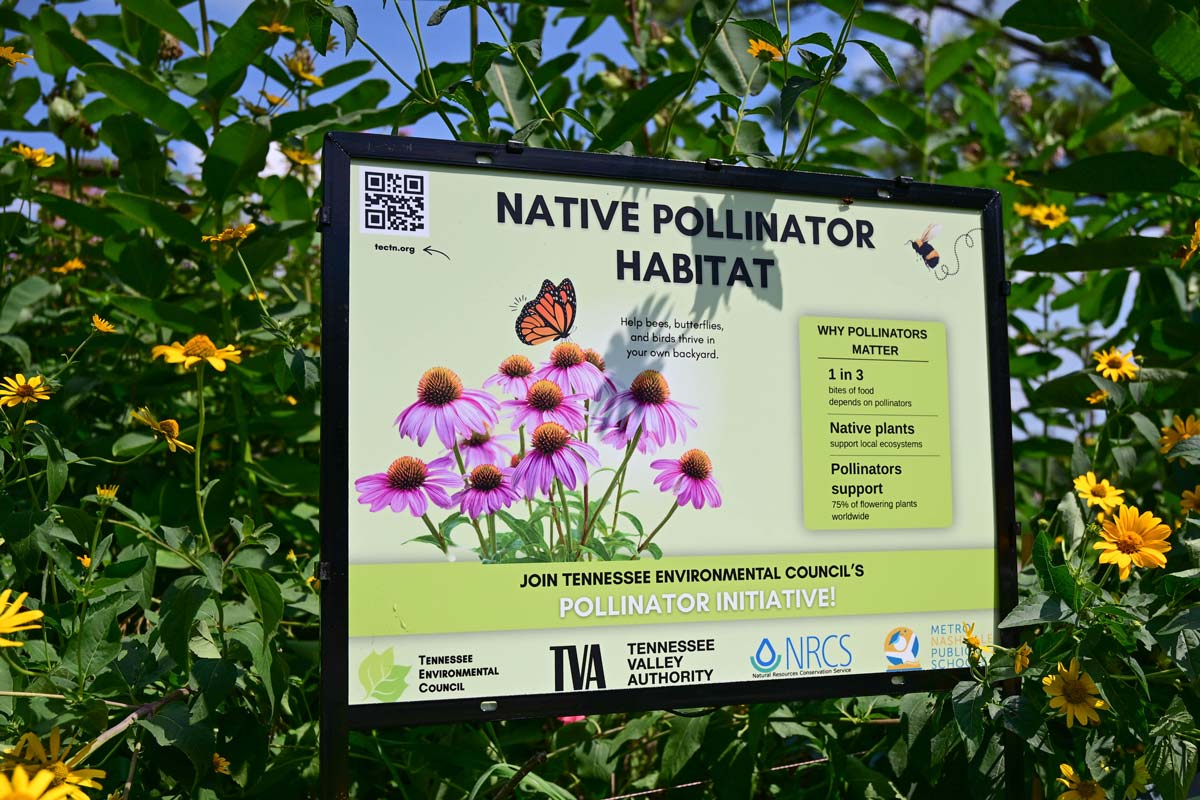
Signs at each garden explain their purpose.
Community workshops teach locals about pollinator-safe mosquito dunk buckets.
They show that flower stalks left standing through winter can shelter next spring’s bee and butterfly babies.
“Tennessee has a lot to offer, and we’re not taught that our state is incredibly biodiverse – or that the biodiversity is disappearing,” Beauchamp said.
Through school gardens, long-term volunteer events, in-person and online education, they’re hoping to teach students and neighbors, one garden at a time.
“Who knows what kind of path you’ll set someone on by involving them,” Hart said. “You’re creating future generations concerned about our lands and environment – it’s full circle.”
What’s the buzz on native bees?
- 350 species of native bees live in the Tennessee Valley region
- Native bees pollinate 80% of flowers and 75% of food crops
- Populations of native bees have plummeted due to grassland habitat loss, lawn and farm pesticide use, invasive species competition and disease
- The American bumble bee population alone has dropped 90% in the last 20 years
- Most native bees – including bumblebees – rarely sting
- 30% are stem-nesting, and 70% are ground-nesting, often living alone
- Bumblebees have distinct stripes that help us I.D. them
- Besides honeybees, only native bumblebees make honey for their larva and queen: “A miniscule amount . . . that they feed to their little ones,” said Pretz
- Different pollinators have ‘favorite’ colors based on what they can see best
- Bees have trichromatic vision to see blue, purple & yellow flowers best
- Flies and beetles prefer white, cream and light green blooms
- Homeowners can help add habitat for native bees
Share this story: ' fill='%23414141'%3E%3Cpath d='M0 0h314v314H0z'/%3E%3C/g%3E%3Cg transform='translate(6 4)'%3E%3Cmask id='d' fill='%23fff'%3E%3Cuse xlink:href='%23c'/%3E%3C/mask%3E%3Cuse fill='%23FFF' xlink:href='%23c'/%3E%3Cg mask='url(%23d)' fill='%23FFF'%3E%3Cpath d='M-149-165h300v318h-300z'/%3E%3C/g%3E%3C/g%3E%3C/g%3E%3C/svg%3E%0A)
' fill='%23414141'%3E%3Cpath d='M0 0h314v314H0z'/%3E%3C/g%3E%3Cg transform='translate(4 5)'%3E%3Cmask id='d' fill='%23fff'%3E%3Cuse xlink:href='%23c'/%3E%3C/mask%3E%3Cuse fill='%23FFF' xlink:href='%23c'/%3E%3Cg mask='url(%23d)' fill='%23FFF'%3E%3Cpath d='M-167-171h323v327h-323z'/%3E%3C/g%3E%3C/g%3E%3C/g%3E%3C/svg%3E%0A)
' fill='%23414141'%3E%3Cpath d='M0 0h314v314H0z'/%3E%3C/g%3E%3Cg transform='translate(4.26 4)'%3E%3Cmask id='d' fill='%23fff'%3E%3Cuse xlink:href='%23c'/%3E%3C/mask%3E%3Cuse fill='%23FFF' xlink:href='%23c'/%3E%3Cg mask='url(%23d)' fill='%23FFF'%3E%3Cpath d='M-150-157h300v300h-300z'/%3E%3C/g%3E%3C/g%3E%3C/g%3E%3C/svg%3E)
Want more stories from The Powerhouse? Sign up to receive a monthly digest in your email.