'%3E%3Cmask id='b' fill='%23fff'%3E%3Cuse xlink:href='%23a'/%3E%3C/mask%3E%3Cuse fill='%23414141' xlink:href='%23a'/%3E%3Cg mask='url(%23b)' fill='%23414141'%3E%3Cpath d='M-160-170h300v300h-300z'/%3E%3C/g%3E%3C/g%3E%3C/g%3E%3C/svg%3E)
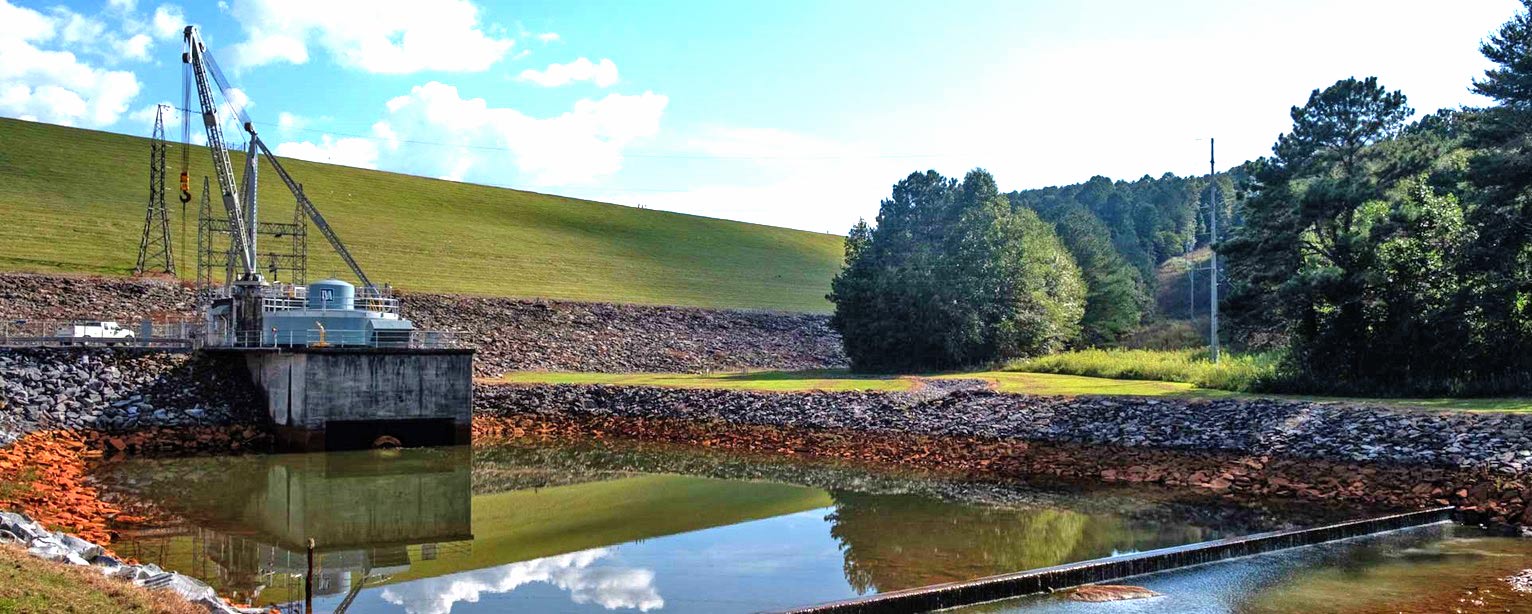
Chatuge Dam Safety Modifications
Update: Jan. 16, 2026
Public safety is a priority for TVA.
To help prepare the public in the event of a potential spillway failure at Chatuge Dam, TVA is sharing inundation mapping for areas downstream of the dam. The risk is low, but if an extreme and rare rainfall event were to cause a spillway failure, TVA wants everyone to know how to protect themselves and their loved ones.
Areas at Risk of Flooding
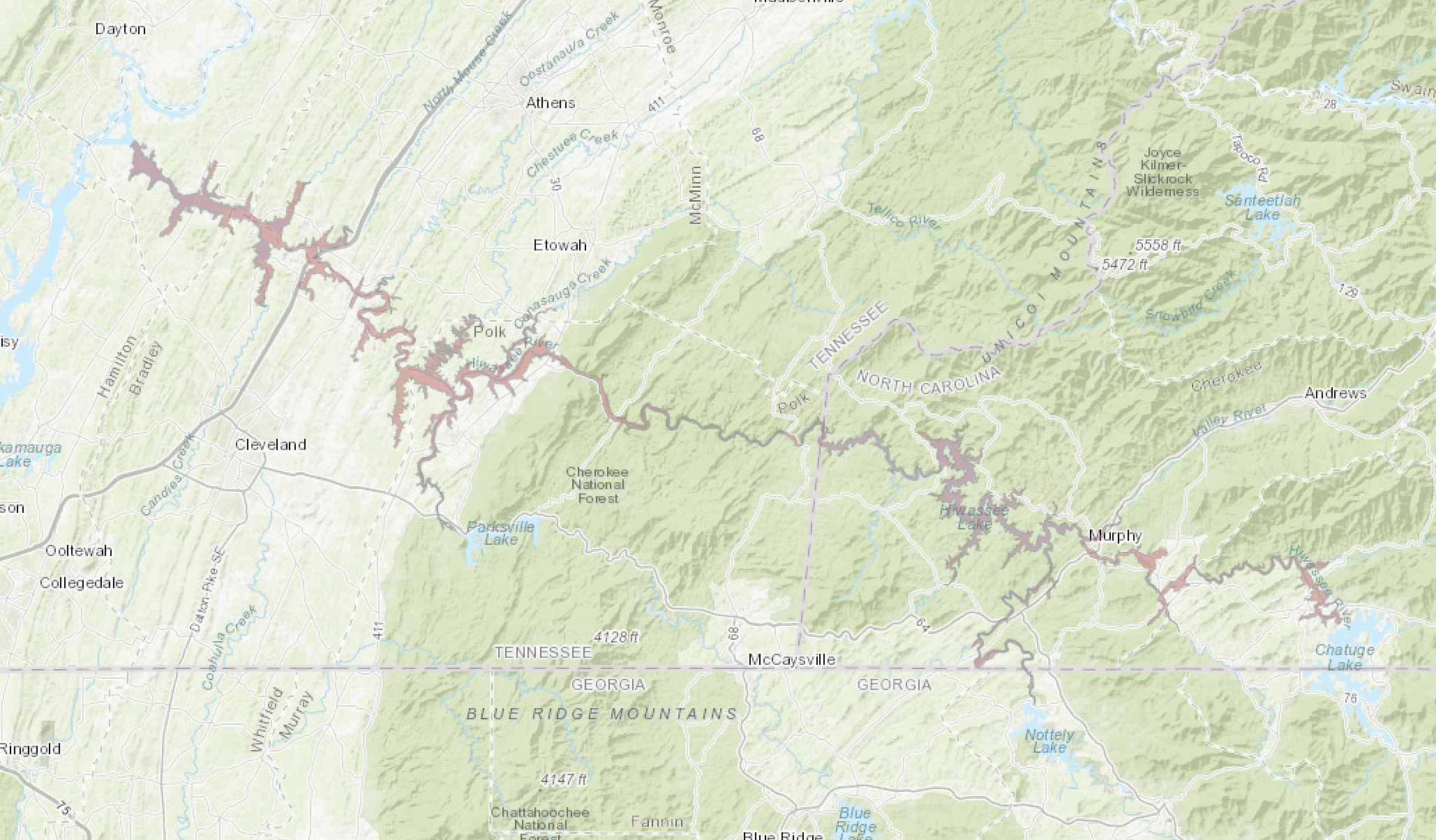 Chatuge Max Inundation Boundary
Disclaimer: "Inundation maps are based on hypothetical flooding or structural failure of a dam or critical appurtenant structure and are developed as an aid for emergency planning and preparedness. The information depicted on the inundation maps is approximate and water may behave differently. Areas to be evacuated in the event of an actual incident are determined by local emergency managers. Neither TVA nor any of its employees makes any warranty, expressed or implied, or assumes any legal liability or responsibility for the accuracy, completeness, or usefulness of any information contained in this product, and assumes no legal responsibility resulting from the use of this information."
Be Prepared
- Review the locations of your home, school, workplace, or other frequently visited locations in comparison to the inundation zones and assess the potential for flooding impacts at your location.
- Set a meeting place outside the inundation zone where your family could gather and identify the routes to reach those locations. Review this information with family members.
- If you will need special assistance to evacuate, make arrangements with others before an emergency. Emergency personnel may not be able to answer all calls for help.
What Evacuation Means for You
Take immediate action if you hear the weather radio alert or receive an SMS message on your phone from emergency management agencies.
- Messages may be sent by authorized government agencies like the Federal Emergency Management Agency or National Weather Service.
- Sign up to receive emergency messages from your county government. Delivery methods typically include mobile phone, email and land-line phones. Data rates may apply.
Dam Safety Modifications Under Review
TVA expects to release a Draft Environmental Impact Statement in early 2026. Once published, the public will have 45 days to provide comments. Additional public open house meetings will be scheduled once the draft EIS is published.
Construction of a selected alternative could begin between summer 2028 and fall 2029.
Alternatives being studied are:
- Alternative A: No Action – TVA would continue to monitor and inspect the spillway, repairing joints and sealing cracks in the spillway slab and walls as they are identified.
- Alternative C: Remediation in Place with Concrete Liner – The existing spillway would be covered with a new concrete liner. The reservoir drawn down would be planned for off-season portions of up to two consecutive years.
- Alternative D: New, Larger Spillway – A new spillway would be built. When complete, the existing spillway would be abandoned. The reservoir drawdown would be planned for offseason portions of up to two nonconsecutive years.
- Alternative E: New Spillway and Repairs to Existing Spillway – A new spillway would be built, with similar capacity to the existing spillway. Once complete, the existing spillway would be repaired for use as a second spillway during rare, extreme weather events. Construction time is estimated at five years. The reservoir drawdown would be planned for offseason portions of up to two nonconsecutive years.
TVA eliminated Alternative B, reconstruction of contraction joints in the concrete spillway, from consideration. Read detailed descriptions of each alternative in the Notice of Intent.
Reservoir Drawdowns
Reservoir drawdowns would be needed for Alternatives C, D and E. Drawdowns would:
- Reduce the water level to an elevation of 1908 feet, about 10 feet below the current winter level.
- Drawdowns would be planned for offseason months – late summer to early spring.
- Return to summer water levels will rely on rainfall. Levels cannot be guaranteed.
View the estimated water levels in the reservoir at 1908 elevation.
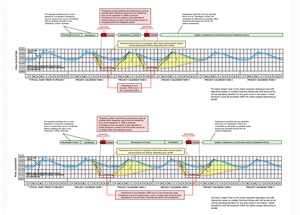
Understanding the Inundation Map
TVA dam safety project manager Chris Saucier explains how residents can use the inundation map of Chatuge Reservoir to prepare for a flood emergency.
TVA dam safety project manager Chris Saucier shares information on how drawdowns at Chatuge may impact area properties.
Estimated Project Timeline
April 2025: Notice of Intent issues
May 2025: Public comment period
Fall/Winter 2026: Draft Environmental Impact Statement issued
Late 2026/Early 2027: Final Environmental Impact Statement issued
Early 2027: Project decision
Summer 2028/Fall 2029: Construction begins
In the News
Local and regional media coverage of the Chatuge Dam and spillway study and community engagement.
Audio Interviews
Chris Saucier Interview (mp3) – May 1, 2026
WKRK, Murphy, North Carolina
Chris Saucier Chatuge Update (mp3) – April 22, 2026
WJUL, Hiawassee, Georgia
Adam May and Chris Saucier Chatuge and Weather Update Interview (mp3) – Jan. 23, 2026
WKRK, Murphy, North Carolina
Adam May and Chris Saucier Spillway and Weather Interview (mp3) – Jan. 20, 2026
WJUL, Hiawassee, Georgia
Georgia News Network (mp3) – Jan. 19, 2026
Chris Saucier Radio Interview (mp3) – Oct. 22, 2025
WJUL, Hiawassee, Georgia
Georgia News Network (mp3) – Sept. 10, 2025
Chris Saucier Interview (mp3) – June 30, 2025
WJUL, Hiawassee, Georgia
Chris Saucier Interview (mp3) – June 27, 2025
WKRK, Murphy, North Carolina
Georgia News Network – June 26, 2025
Chris Saucier Interview (mp3) – June 11, 2025
WKRK, Murphy, NC
Chris Saucier Interview (mp3) – May 27, 2025
WJUL, Hiawassee, Georgia
Adam May and Chris Saucier Interview (mp3) – April 25, 2025
WKRK, Murphy, North Carolina
Georgia News Network (mp3) – April 22, 2025
Chris Saucier Interview (mp3) – April 21, 2025
WJUL, Hiawassee, Georgia
Chris Saucier Interview (mp3) – April 7, 2025
WJUL, Hiawassee, Georgia
Chris Saucier Radio Interview (mp3) – Jan. 18, 2024
WJUL, Hiawassee, Georgia
News Articles
Spillway at the Chatuge Dam – April 30, 2026
Clay County Progress, Hayesville, North Carolina
Clay county progress map story – Jan. 22, 2026
Clay County Progress, Hayesville, North Carolina
Chatuge Dam safety project scoping report released by TVA – Sept. 11, 2025
Clay County Progress, Hayesville, North Carolina
TVA releases interactive lake drawdown map – Sept. 10, 2025
Towns County Herald, Hiawassee, Georgia
Modifications to spillway refined, drawdown revised – July 3, 2025
Clay County Progress, Hayesville, North Carolina
TVA revises lake drawdown to two off-seasons – July 2, 2025
Towns County Herald, Hiawassee, Georgia
New Lake Chatuge spillway repair projections a ‘big win’ for locals – June 26, 2025
Georgia Outdoor News
TVA refines plan for Lake Chatuge Dam repairs – June 26, 2025
The Atlanta Journal-Constitution
Rep. Clyde applauds TVA’s rational approach to address Chatuge Dam spillway vulnerabilities – June 25, 2025
Press Release, Gainesville, Georgia
Rep. Clyde visits Chatuge Dam to advocate for a sensible approach to address spillway vulnerabilities – April 21, 2025
Press Release, Gainesville, Georgia
Chatuge Dam safety modification study underway – April 3, 2025
Clay County Progress, Hayesville, North Carolina
Spillway fix to bring record-low lake levels – April 2, 2025
Towns County Herald, Hiawassee, Georgia
Multi-year safety study underway at Chatuge Dam – Dec. 28, 2023
Clay County Progress, Hayesville, North Carolina
Project Background
TVA carefully inspects its dams according to best practices in dam safety. Our dams were built to stand the test of time. Maintenance, repairs and modifications ensure continued safe operations.
New standards led to concerns about Chatuge’s spillway. The spillway releases water from the reservoir. The concrete slabs, and the drainage system beneath, have deteriorated over time. Using the spillway during an extreme weather event for an extended period could damage the spillway and, potentially, the dam.
TVA errs on the side of caution. Chatuge Dam and reservoir are critical to the safety and well-being of communities nearby and downstream. We’re focused on reducing the potential risk and ensuring the dam’s long-term safe operations.
Dam safety risk considers:
- How likely something could happen, like a breach of the spillway
- How many people would be harmed if something happened, including lives lost and property damaged
While Chatuge Dam and spillway are safe for operation, the risks associated with an extreme and rare rainfall event are outside TVA’s acceptable risk tolerances. In the event of a spillway breach, there are many people who could be affected in some way, such as loss of life or property.
Chatuge Dam Facts
- Chatuge Dam and spillway are safe for operation.
- There is a risk of water flowing over the spillway for an extended period, during a rare and extreme weather event, could damage the spillway.
- TVA continues to monitor Chatuge Dam and perform repairs to the spillway.
- A drawdown of the lake would bring the water level to 1908 feet, approximately 10 feet below winter pool level.
- TVA does not have a preferred alternative at this time.
- The Draft Environmental Impact Statement (EIS) evaluating the alternatives is expected to be completed in late 2025/early 2026. The environmental impact study for the project will continue into 2027 with a decision anticipated in early 2027. Construction could begin between late summer 2028 and early fall 2029.
- Construction of Chatuge Dam began July 17, 1941 and was completed February 12, 1942.
- Chatuge Reservoir covers an area of 7,000 acres.
- Recreational facilities that could be impacted by a potential project identified at this time include:
- 10 campgrounds
- 9 marinas
- 17 boat ramps (including marinas)
- 6 paved trails
- 6 fishing piers
Frequently Asked Questions
During public meetings in May 2025, individuals submitted nearly 200 questions regarding the dam safety modification study at Chatuge Dam. Questions have been consolidated and categorized. As new information becomes available, questions will be dated to inform the public.
What are Alternatives B and C?
Instead of building a new spillway, these options seek to rehabilitate the existing spillway as well as replace the Howell Bunger Valve, which allows water to flow through the dam absent power generation. The spillway would be rehabilitated by reconstructing the existing contraction joints (Alternative B) or by installing a concrete overlay in the footprint of the existing spillway (Alternative C).
If TVA were to select either of these options, we would be working to repair the spillway while simultaneously maintaining the ability to use the spillway during construction should there be a significant rain event. That uncertainty of how often we would need to accommodate using the spillway during construction increases the need for reservoir drawdown to mitigate potential threats to worker safety and dam safety. This is an important factor in the duration of construction.
The estimated reservoir drawdown duration for Alternative B would be approximately eight years, and six years for Alternative C.
Has TVA considered building a new dam?
We took all options into consideration, including a new dam. Due to a variety of factors, including timelines, TVA is not considering construction of a new dam at Chatuge.
What are the benefits or differences between all the options?
The Environmental Impact Statement is evaluating the impacts (both beneficial and adverse) associated with each of the alternatives.
Is Alternative A (No Action) being considered as a legitimate alternative?
All proposed options are being considered.
If you choose the no action Alternative A and conditions worsen, what will happen?
If Alternative A is selected, TVA would continue to monitor and inspect the spillway, repairing joints and sealing cracks in the spillway slab and walls as they are identified. However, the risk of spillway damage and failure in Alternative A would continue to exceed TVA’s risk tolerance.
If monitoring indicates risk of further spillway damage and/or failure, the reservoir could be drawn down until repairs or safety concerns caused by worsening conditions are remediated.
Would any of the alternatives reduce seasonal water elevation changes?
The reservoir pool would be drawn down to elevation 1908, with pool elevations during the drawdown controlled solely by releases through the powerhouse. For the most frequent rainfall events – those which do not raise the pool above elevation 1923 – the alternatives are identical in their ability to regulate the pool during any drawdown.
After construction, TVA intends to return the pool to its usual annual cycle of operations. For long-term operations, the alternatives are identical with respect to ability to regulate the pool along its normal cycle of fluctuation.
Do the revised drawdown timeframes impact project costs?
Project cost estimates continue to include relatively high levels of uncertainty at this stage. While recently developed costs vary from prior estimates, current cost estimates are not yet finalized to a degree which allows for detailed comparisons between the proposed alternatives.
How much will the repairs cost?
Cost will be dependent on final design and the alternative selected. As part of our assessment, TVA works diligently to assess the needed time and budget to complete each of the proposed modifications.
Who pays for the study? How is the project funded?
Both the study and the resulting design and construction are funded through TVA’s budget for dam safety projects. TVA does not receive appropriations from Congress.
Do you have cost bids yet?
No.
Does TVA anticipate it has the budget available to complete the work and that timelines will be kept? Will federal budget cuts impact the project?
TVA has worked diligently to assess the needed time and budget to complete each of the proposed modifications to the spillway and will strive to continually keep the public informed of all efforts related to Chatuge. TVA funding for the dam safety project at Chatuge is not reliant on funding from other federal agencies or any external third parties.
Will this project change my electricity rates?
TVA operates as a public power utility, meaning it’s not focused on profit, but on serving the public interest and ensuring low rates. Our rates are affected by factors like fuel costs, capital investments and the need to meet growing energy demand.
Is the Chatuge project impacted by NEPA Executive Orders?
TVA is still obligated to evaluate the environmental and social impacts of the proposed action under the National Environmental Policy Act. These evaluations include a study of socioeconomic impacts, which is a standard component of the NEPA reviews. This analysis will inform TVA’s final decision.
Is TVA subject to possible action by the federal government to restrict spending?
TVA funding for the dam safety project at Chatuge is not reliant on funding from other federal agencies or congressional appropriations. TVA has worked diligently to assess the needed time and budget to complete each of the proposed alternatives.
Could TVA implement a Special Purpose Local Option Sales Tax to accelerate the timelines?
This is not something that TVA could implement.
Are economic impacts to the local communities considered part of the Environmental Impact Statement? If so, why?
Socioeconomic impacts are an important component of TVA’s NEPA review and will be part of the EIS. This analysis will help inform TVA’s final decision and will be available for public review and comment as part of the draft EIS.
When will you issue the economic study results? Will there be a comment period?
Analysis of socioeconomic impacts will be included in the draft Environmental Impact Statement. The draft EIS is currently scheduled to be released in late 2025 or early 2026 and will include discussion of the socioeconomic study findings. There will be an opportunity for public comment on the draft EIS.
Has this kind of repair been completed on another dam and what was the economic impact on the surrounding communities?
While there are no other projects with the exact repairs, conditions or circumstances like those at Chatuge, there have been remediations of spillways like the one at Oroville we can study. TVA’s analysis of potential socioeconomic impacts will be tailored to local conditions and the specifics of this project. The proposal for the economic study includes a comparison/contract evaluating the impact of low lake levels on local economies.
How will this project impact real estate and recreational opportunities? Will you compensate businesses and individuals for losses?
TVA is currently in the information gathering phase of the project. TVA plans to conduct a socioeconomic study to understand potential impacts and inform future actions.
What stakeholders have been engaged in the process thus far?
TVA has engaged a number of stakeholders in the community, including local, state and federal officials, regulatory agencies, federally recognized tribes, businesses such as recreational operators, utilities and the public.
We have worked with news outlets to share information, placed advertising, promoted public engagement on social media, mailed postcards and conducted two in-person open houses and two virtual meetings. Nearly 500 individuals attended the open houses and more than 1,700 comments were received from the public.
Has the Army Corps of Engineers been involved?
Yes, the Army Corps of Engineers has been heavily involved in studies conducted to date. TVA maintains close working relationships with colleagues in the Corps of Engineers.
What is wrong with the Chatuge spillway?
If a large volume of water flows quickly over the spillway, that water could lift the concrete slabs. Once a slab is lifted, the ground is exposed to the force of the water, which could erode the spillway all the way back until it breaches the reservoir. Breaching means a failure of the dam to hold back the water.
Why and when did TVA start looking at potential issues at Chatuge?
After the California-based Oroville Dam failure in 2018, TVA performed extensive investigations to see if Chatuge had the same potential vulnerability to its spillway. TVA has judged the spillway at Chatuge Dam exhibits some vulnerability to this potential failure mechanism and has chosen to address the issue proactively.
Additionally, the dam safety profession has moved toward incorporating greater consideration of downstream consequences within evaluations of dam safety. TVA has been integrating this approach into its dam safety program as part of its ongoing commitment for all TVA dams to conform to modern standards for public protection. This change in industry practices is one factor in TVA’s efforts to increase the safety of Chatuge Dam.
How many times is the spillway used each year?
Over much of the site’s history, a period of five to 10 years may pass between activations of the spillway, though the spillway may have been used several times during those years when it was activated.
Since 2004, the spillway has been activated 24 times. The spillway was last activated in May 2025.
What are you doing to ensure the safety of the spillway and dam before work begins?
We have implemented several activities to ensure ongoing safe operations, including increased monitoring of the dam, increased interactions with local emergency management agencies, and placement of emergency response resources at or near the site.
Will TVA consider treating the modifications to the spillway as an emergency situation, like Oroville, to expedite repairs?
The risk at Chatuge is not an emergency with regard to safety of the dam. We’ve used the example of Oroville Dam to describe the basic problem we are trying to mitigate. In the aftermath of Oroville, the spillway there existed in a condition of initial failure such that it could not be used to spill water to prevent overtopping of the dam. We are still able to release water over the spillway at Chatuge to control common rainfall events.
Though not deemed an emergency in dam safety terms, TVA is acting with heightened urgency to evaluate and minimize impacts to the local communities.
Can TVA provide probable maximum flood maps, including flood plain inundation in case of breaches?
To help prepare the public in the event of a potential spillway failure, TVA is sharing inundation mapping at Chatuge Reservoir to demonstrate the potential areas downstream of the dam that could be flooded. Review the map.
Will TVA extend launch ramps to allow the public continued access?
While temporary disruptions may be necessary, TVA will be working closely with local and state governments to maintain access to launch ramps.
Can I extend my dock? Can I build a dock during the drawdown?
Given the seasonal nature of the drawdown and expectation that the reservoir will reach normal summer pool levels, TVA is not planning to consider requests to extend water use facilities that deviate from TVA’s Section 26a Regulation 1304.204(c). Any requests to build or modify a dock will be subject to Section 26a regulations and all applicable fees.
Given that the existing proposals entail multiple years of construction, what benefits to shoreline cleanup and other lake improvements can lake property owners expect?
TVA will continue to work with the community as further information about the drawdown period becomes available.
Can I dredge a channel to the reservoir?
TVA authorization is required to dredge or excavate property owned by TVA. Proposed channel excavations on TVA-owned residential access shoreline are subject to the requirements of TVA’s Section 26a regulations and all applicable fees.
Dredging or excavation of a new channel or enlargement of an existing channel on private land or within TVA’s flowage easement requires TVA’s review where it is associated with a Section 26a permitting activity. These activities that are subject to Section 26a permitting include the construction of a private water-use facility or the placement of the dredged or excavated material within the 500-year floodplain. Requests for dredging or channel excavation should also be directed to the U.S. Army Corps of Engineers (USACE) to determine whether USACE authorization is required. This activity may also require other federal, state or local permits, and it is the applicant’s responsibility to ensure that all appropriate permits are obtained and that the activity complies with all applicable federal, state and local requirements.
Will the public retain access to the crest road during construction?
The safety of the public is our top priority. Due to large equipment and potential hazards, access to the crest road will not be available during construction.
What is the risk to fish and game?
Impacts to fish and game will be considered in the Environmental Impact Study.
Has the Georgia Department of Natural Resources or the North Carolina Wildlife Resource Commission made any comment on how this will affect fish?
TVA notified the Georgia Department of Natural Resources and North Carolina Department of Environment and Natural Resources of our intent to prepare an Environmental Impact Statement.
Will beaches be affected?
We expect that once water levels drop, more of the shoreline will be exposed, extending the distance to the water. A Section 26a permit would be required for any shoreline improvements. TVA will be working closely with recreation operators who request changes to their facilities.
In the event of a prolonged drawdown, how and who will be responsible for controlling vegetative growth and maintaining the exposed soil surface for up to 8 years?
Decisions on vegetation control are dependent on which option is chosen and the corresponding drawdown period. TVA will maintain communication with the public as further information is available.
Will the drawdown impact the invasive Parrot Feather on Chatuge?
Any potential impacts on Parrot Feather at Chatuge Reservoir will require further analysis. TVA will perform surveys once water levels return to normal to see if additional treatment is warranted if the invasive species starts to regrow.
Are the times for construction and drawdown finalized?
No. Estimates of both the construction periods and the drawdown durations are very preliminary. More information and analysis is needed to firm up those times. There may be opportunities to bring those durations down. TVA will continue to communicate as the project progresses.
What is the anticipated start date of the construction?
Current projections are for a start date between late Summer 2028 and early Fall 2029. This date represents the initiation of construction work on permanent components of the spillway remediation. Prior to that date, though, visitors to the site may observe activities which support the targeted start date. These activities may include the drilling of soil and rock cores and the building of temporary infrastructure
The webpage previously stated construction may start earlier. What has caused the delay in the planned date for start of construction?
TVA identified an opportunity to combine several planned projects at the site into a single project, the largest component of which is the spillway remediation. Under the requirements of the National Environmental Protection Act, TVA is required to adjust public-facing records of the project to reflect any such changes, and these changes will be included in the forthcoming Draft EIS for the spillway project. While the start date for the project has been delayed several months, planned durations of the design and construction periods have been reduced so that the completion date remains unchanged.
Why is a cofferdam not being considered?
All four proposed modifications already assume a cofferdam – a temporary damming structure that holds back water around a construction area – will be required for each alternative during construction. It is important to note that the presence of a cofferdam does not eliminate the need for a lake drawdown, though the cofferdam may be capable of limiting the duration of construction or potential drawdown. Cofferdams would be removed after construction.
Why does it take up to eight years to repair a dam?
TVA does not have estimates of the durations of construction for each alternative because the current designs of the alternatives are concept-level. For this reason, TVA is communicating upper-bound durations for the construction period and drawdown for the various alternatives. The eight-year upper-bound duration of construction is specific to Alternative B. The estimate reflects the high degree of uncertainty regarding how often TVA may need to evacuate the spillway and seal up partially completed work to allow for the possibility of the spillway being activated by an incoming storm.
This early in the study, TVA’s approach has been to use upper bounds to describe the potential durations of construction and the potential durations of reservoir drawdown with the understanding we will be working to decrease those durations for all alternatives, if possible.
Do the time estimates assume a standard work week or 24/7 construction schedules?
Current estimates are associated with the assumption of four 10-hour workdays per week. This work schedule has been combined with benchmarking data for similar projects and adjusted to include uncertainties about spillway activation. Optimization of construction sequences and work schedules will be studied further for each of the alternatives.
How were you able to reduce the drawdown timeframes?
TVA completed the first of several planned refinements to the project schedule. In this recent effort, the project team worked to optimize the sequencing of construction efforts for each alternative to reduce overall construction time and to consider the scheduling of critical activities to coincide with drawdowns of limited duration.
Why did you release the original drawdown timeframes when you knew they would be revised?
TVA is using a process where work performed to develop and refine dam safety design concepts is conducted in parallel with studies associated with the National Environmental Policy Act.
As part of the NEPA process, TVA posts a Notice of Intent, which includes those initial design concepts, to show the public what is being studied. At the same time, TVA is collecting more information and refining those concepts.
In the past few weeks, we have completed the next planned steps in the study related to construction sequences. This step heavily engaged construction staff to optimize construction steps and sequences in a way which minimizes impacts from any required drawdown.
Does the drawdown have to be year-round? Can we keep the pool up during the summer recreation months?
June 25, 2025: New estimates for the drawdowns are expected to allow for the reservoir to return to summer pool during the spring and summer recreational season. Drawdowns would be planned for late summer to early spring. Refilling the reservoir would depend on rainfall and construction delays could alter timelines, so water levels cannot be guaranteed.
For Alternative C, the drawdown will be required during construction of critical chute components located near the existing spillway gates. However, restrictions on pool levels could be lifted once these critical components are in place and judged safe against potential flows over the spillway.
In Alternatives D and E, the drawdown is required to ensure temporary cofferdams are constructed and verified as capable of providing the same level of safety as the dam itself. The drawdown associated with these alternatives would be required during the periods associated with construction and verification of the cofferdam(s) and during periods associated with the verification of the dam and spillway conditions when the cofferdams are removed.
Do the estimates for the drawdown include the period to refill the reservoir?
Yes, the current upper-bound durations of pool drawdowns for each alternative include the amount of time required to recover normal pool operations after the drawdown.
Do you have maps showing where the water level will be during the drawdown?
June 2025: Current estimates of the location of the 1908 elevation contour are based on 1920s-era United States Geological Survey maps. It’s almost certain that the lake bed has changed from that time. TVA has initiated an effort to collect bathymetry data which will allow us to trace that contour over the entire reservoir. Once this data has been validated and assembled into a graphical form, TVA will make those maps publicly available.
April 2025: TVA does not currently have maps which accurately depict this contour, as the contour is below the typical water surface elevation. TVA intends to obtain data to better define the location of this contour at various locations around the reservoir during the coming year.
Will other utilities be impacted by the drawdown? Will TVA maintain minimum flows for water supply and aquatic health?
TVA has consulted with local utilities, and we don’t anticipate any repercussions for their operations. TVA will be able to maintain minimum flows to ensure water supply and aquatic health.
Stay Informed
Sign up for our newsletter to get the latest updates on our safety efforts at Chatuge Dam.