'%3E%3Cmask id='b' fill='%23fff'%3E%3Cuse xlink:href='%23a'/%3E%3C/mask%3E%3Cuse fill='%23414141' xlink:href='%23a'/%3E%3Cg mask='url(%23b)' fill='%23414141'%3E%3Cpath d='M-160-170h300v300h-300z'/%3E%3C/g%3E%3C/g%3E%3C/g%3E%3C/svg%3E)
Shooting Creek, North Carolina (Clay County)
The proposed project involves TVA building a new 161 kV transmission tap for the proposed Shooting Creek Substation, while Blue Ridge Mountain EMC (BRMEMC) constructs the substation with at least four circuits connecting to existing distribution lines. This plan offers the most reliable and efficient solution for handling load growth, providing increased reliability and less exposure to individual circuits. It is the most economical option and a better long-term solution for future load growth.
TVA proposes to build about 7.7 to 9.5 miles of single-circuit, 161-kilovolt power line to serve the new substation. The proposed power line would begin somewhere along the line between TVA’s Hayesville and Woods Grove stations at a point either near the Hayesville station or near the Chatuge dam. From the connection point, TVA’s new line would extend east to Blue Ridge Mountain EMC’s Shooting Creek Substation.
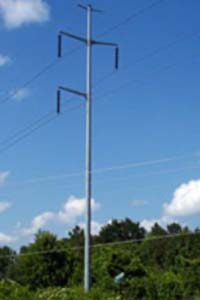
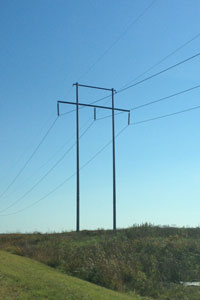
The line would be built using primarily 2-pole H-frame structures ‑centered on new 100-foot-wide right of way. TVA is considering 90 alternative routes consisting of 22 alternative segments for the path of the new power line.
TVA hosted a public open house related to the project on Dec. 4, 2025, and a 30-day public comment period also began on that date. Feedback received during the initial comment period provided valuable information to support a thorough analysis of options being considered. TVA will continue to accept feedback until a decision is made on a preferred route. Comments can be submitted by contacting TVA's John West toll-free at 800-362-4355, by email at [email protected], or by mail to: John West, Tennessee Valley Authority, 1101 Market Street, MR4G, Chattanooga, TN 37402-2801. In addition, TVA has extended the time period that individuals can share comments through its online virtual open house: tva.com/virtual/shooting-creek.
TVA will take the analysis and feedback from the public on the alternative route options and select a preferred route that will be announced in Summer 2026. The TVA transmission siting team will continue to engage the public and have conversations with impacted property owners after the preferred route selection is announced and throughout the remainder of the project.
The project is expected to be in service in 2029. Construction is scheduled to begin in Winter / Spring 2028. (Dates are subject to change. Unexpected issues may arise, resulting in the need to adjust the schedule.)
Frequently Asked Questions
Why did TVA not include a route option along the Hwy 64 Corridor?
This option was evaluated during TVA’s initial routing study and was not advanced as an alternate route. In response to subsequent community input, TVA revisited and conducted a more detailed assessment of this approach. Following that additional review, TVA determined that routing a new 161 kV transmission line along Hwy 64 is not feasible.
This decision was made due to the considerable design, construction, maintenance and outage constraints it would involve, both for TVA and Blue Ridge Mountain EMC. Also, the Hwy 64 Corridor route presents risks associated with potential widening of Hwy 64 in the future. Additionally, highway right-of-way corridors are typically more suited for smaller scale utilities, such as lower voltage electric, gas, water and sewer, that don’t have the easement footprint of high voltage transmission lines.
Further details on why TVA determined this was not a feasible option are below:
- Dense development along the highway – homes, businesses and other structures make it a difficult choice as TVA would impact each of these to build lines. Existing homes and other permanent structures would have to be removed to accommodate a 100-ft right-of-way.
- Future highway projects could force expensive relocations – if the road is widened later, the line would likely have to be moved. In terms of moving lines, TVA would have to relocate our lines and possibly encroach on additional houses/buildings or to re-route the line altogether at a significant cost to TVA and its customers.
- Highway corridors are better utilized by utilities such as local electric, gas or water lines. This is due to the smaller footprint of their easements, thus resulting in a lesser impact on adjacent infrastructure.
- Currently, BRMEMC has existing poles they utilize for power distribution along the Hwy 64 Corridor. The notion of TVA sharing routes with BRMEMC would require outages during construction and maintenance – their line would need to be taken out of service during construction and maintenance. This would create lengthy disruptions in service, meaning power outages for homes and businesses in the area.
Can TVA build the transmission line across the bottom of Lake Chatuge?
TVA enlisted an independent engineering analysis on the means of construction and associated cost estimates of this project. This analysis found that the construction of a submarine route for a 161-kV transmission line under Lake Chatuge would involve multiple complexities, resulting in significant cost increases and long-term impacts to Lake Chatuge. Further details on these challenges are included below:
Budget and Schedule: Based on input from experts with experience in underwater utility work, it is estimated that a route across the bottom of Lake Chatuge is likely to exceed $100 million. This is potentially 10 times the estimated cost of the overhead options under consideration and would delay the projected in-service date by 5 years.
Maintenance and Reliability: The review determined that because Lake Chatuge is not accessible via barge delivery or other traditional installation methods for underwater transmission lines, the method required for cable installation under Lake Chatuge would introduce significant reliability concerns and other complexities that introduce potential for increased maintenance costs over the life of the line.
Environmental/Recreational Impacts: Based on the information gleaned from the independent analysis, TVA identified environmental and recreational impacts, along with additional review and permitting that would further impact the schedule and resulting reliability challenges. Cable installation could increase turbidity, sediment plumes, or localized shoreline impacts, which would have multiple impacts requiring further analysis. Where the line would be submerged in Lake Chatuge, there would be restrictions on boating and recreational activities for the duration of construction and during any future maintenance or inspection. In addition, other activities to support the construction could also temporarily affect recreation, boating, and shoreline users at Lake Chatuge, and the specific impacts would require further analysis.
Impacts to Lake Chatuge Property Owners and Local Community: This type of underwater design and construction would have significant impact to property owners on or near the lake, the general public who use the lake for recreation, and others in the community.*
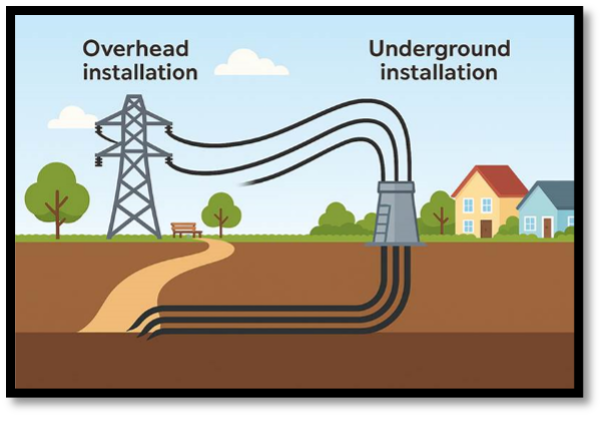
For example, prior to and after running under Lake Chatuge, the transmission line would need to transition between overhead and underground installation. This requires a specialized structure commonly called a termination or riser structure that would typically house surge arrestors and fiber-optic splice boxes. The location, construction, and maintenance of this structure would be much more impactful to a property owner compared to a typical directly imbedded pole structure due to the need for excavation for foundations and concrete duct banks to house the underground cables, which would prohibit any agricultural or ground disturbing activities within the easement.
*TVA would not move forward with a route selection without first providing public notice and the opportunity for feedback from impacted property owners and the general public.
Given the significant technical, logistical, cost, and reliability concerns, as well as potential environmental impacts, TVA has determined that routing the new 161-kV transmission line along the bottom of Lake Chatuge is not a feasible option. TVA continues to evaluate the route options that have been previously presented to the public with plans to make a preferred route announcement this summer.
Is this project related to future plans for data centers or crypto loads?
Neither TVA nor Blue Ridge Mountain EMC have plans for a data center or crypto load in this area.
Is a project of this scale needed to support the current and future load forecasts in the area?
Yes. The new 161-kV line also provides needed voltage support on TVA’s system. In addition, the new Shooting Creek substation will reduce the length of new distribution lines needed to serve the area.
Submit Comments About the Project
Map
The map shows the area of the proposed transmission improvements. The map is also available below as a PDF file.
If you have questions or need help understanding the map, please contact TVA (see below).
Shooting Creek, NC Open House Map
Project Schedule
(Dates are subject to change. During projects of this magnitude, unexpected issues may arise, resulting in the need to adjust the schedule.)
| Open House | December 4, 2025 |
| Comments accepted through | Spring 2026 |
| Determine preferred route for field surveys | Summer 2026 |
| Surveys of the right of way are scheduled to begin | Fall / Winter 2026 |
| Easement purchases are scheduled to begin | Summer / Fall 2027 |
| Construction is scheduled to begin | Winter / Spring 2028 |
| Project in service | 2029 |
Environmental Reviews
The appropriate National Environmental Policy Act review will be conducted to ensure that the environmental impacts are minimized. TVA attempts to minimize any land requirements, private property impacts, and environmental impacts associated with this project.
Efforts are made during the siting process to avoid or minimize impacts to floodplains and wetlands in accordance with Executive Orders 11988 and 11990. Floodplains and wetlands are shown on the referenced map. The map illustrates how the route avoids or impacts floodplains and wetlands. Because of project and topographic constraints and because of minimizing impacts to other social, environmental, and engineering resources, no practicable alternative may be available that would allow complete avoidance of impacts to floodplains and wetlands which may require mitigation for minimizing impacts. Also, best management practices would be utilized throughout the project to minimize adverse floodplain and wetland impacts. In compliance with Section 404 of the Clean Water Act, TVA will be coordinating wetland findings with U.S. Army Corps of Engineers.
Contact
More information on this project can be obtained from:
John West
[email protected]
800-362-4355
1101 Market Street, MR 4G
Chattanooga, TN 37402-2801